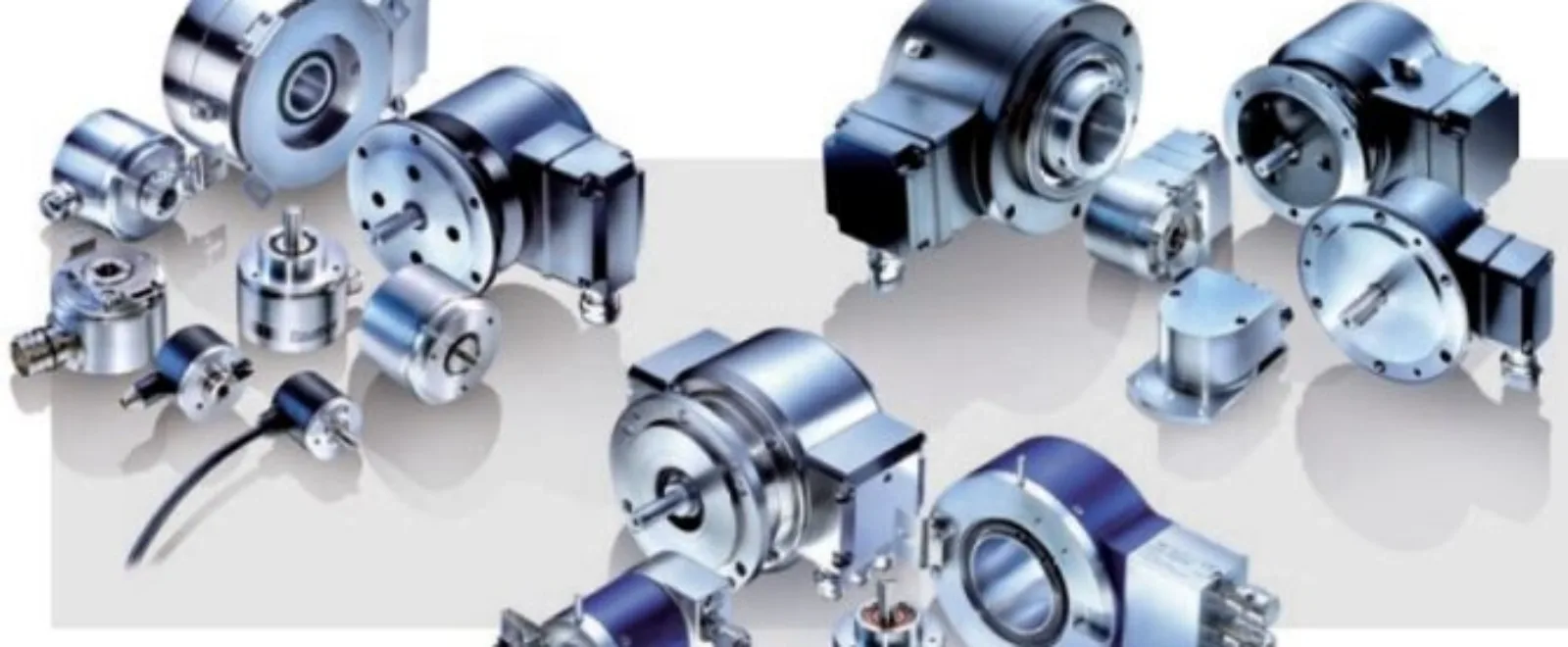
Selecting the right encoder can make the difference between a smooth-running, high-performance system and low downtime. Encoders are the heart of every motion control system, converting mechanical movement into precise electrical signals for monitoring and control. But with so many types, resolutions, and configurations available, encoder selection can seem complex.
At Euro HÜBNER Benelux B.V., we help engineers and technical buyers across Europe to choose the right rotary encoders for demanding industrial applications. This guide explains the key factors you should consider to ensure optimal accuracy, durability, and compatibility with your control system.
1. Define the type of motion: rotary or linear
The foundation of every encoder selection is the type of movement you need to measure.
Rotary encoders measure angular motion, translating shaft rotation into position, speed, or direction data. They are the most common choice for cranes, conveyors, wind turbines, and drive systems that require rotational feedback for motor control or synchronisation.
Linear encoders, on the other hand, measure straight-line displacement rather than rotation. They’re ideal for machine tools, lifting systems, inspection tables, and precision positioning equipment, offering high-resolution feedback over linear travel.
In short, rotary encoders measure rotation, while linear encoders measure distance, and many modern systems use both for full motion feedback.
2. Choose between incremental and absolute encoders
Once you know your motion type, the next key decision is the signal principle.
Incremental encoders output pulses that indicate relative movement. They’re perfect for monitoring speed, direction, and distance, especially in continuous processes or motor control. Incremental encoders like the POG10 are valued for their robustness and cost-efficiency.
Absolute encoders, in contrast, assign a unique digital code to each position. This means they retain position information even after power loss, making them indispensable in automation, robotics, cranes, and lifting applications. The Baumer HMG10 absolute encoder, for instance, ensures accurate multi-turn feedback even under heavy mechanical stress.
If your system needs to remember its exact position after a restart or a power outage, an absolute encoder is the right choice.
3. Determine the required resolution and accuracy
The resolution of an encoder defines how many discrete measurement steps it can detect per revolution (for rotary encoders) or per millimetre (for linear encoders). High-resolution encoders provide finer accuracy, which is essential in CNC machines, inspection systems, and servo control.
Incremental encoders typically range from 100 to 10,000 pulses per revolution (PPR), while absolute encoders can offer resolutions up to 18 bits per turn or more.
However, higher resolution doesn’t always mean better performance. If the mechanical setup of your machine is not equally precise, excessive resolution can introduce signal noise or unnecessary processing load on the controller.
At Euro HÜBNER Benelux B.V., our experts help you determine the ideal balance between resolution, speed, and signal stability to optimise performance in your specific environment.
4. Consider environmental and mechanical factors
Encoders often operate in harsh industrial conditions, so their mechanical design and protection level are just as important as their electrical characteristics.
The heavy-duty encoders from Euro HÜBNER Benelux B.V. are engineered to perform reliably under vibration, shock, and temperature fluctuations. The HOG10 and POG10 series are available with IP67 protection, corrosion-resistant housings, and reinforced bearings, which makes them ideal for marine, offshore, and heavy machinery applications.
When selecting an encoder, evaluate:
- Ingress protection (IP) for dust and moisture resistance
- Temperature range, especially in outdoor or high-heat installations
- Vibration resistance is crucial for cranes or steel production environments
- Material selection, such as aluminium or stainless steel housings for durability
Choosing an encoder designed for your conditions ensures consistent signal output and longer service life.
5. Match the electrical interface to your control system
An encoder’s output interface must be compatible with your controller, PLC, or drive. The wrong interface can lead to unreliable data transmission or communication errors.
Incremental encoders typically use TTL (5 V) or HTL (10–30 V) square-wave outputs on channels A, B, and Z. For better noise immunity and long cable runs, RS422 differential signalling is recommended.
Absolute encoders communicate via digital fieldbus or network protocols such as SSI, CANopen, PROFIBUS, or PROFINET. The right choice depends on your control system’s architecture and the update rate that is needed.
6. Ensure mechanical compatibility and correct installation
Even the best encoder can fail prematurely if installed incorrectly or mismatched mechanically. Pay attention to shaft type, coupling design, and mounting method.
Solid-shaft encoders require precise alignment and a flexible coupling to avoid bearing stress, while hollow-shaft encoders allow easier installation and better vibration resistance. Proper installation also involves securing cables with strain relief and maintaining adequate bending to prevent internal wire damage.
Euro Hübner Benelux B.V. provides detailed installation guides and mounting accessories to help you achieve reliable alignment and mechanical stability from day one.
7. Think about maintenance, service life, and future support
Encoders are long-term components, often operating continuously for years. Choosing models with sealed bearings, high-quality connectors, and diagnostics options ensures reduced maintenance and predictable performance.
Heavy-duty encoders such as the HOG10 include features like reinforced shafts and corrosion-resistant coatings that extend service intervals and reliability.
Euro Hübner Benelux B.V. also offers fast replacements and drop-in compatible models for legacy or discontinued encoder types to minimise downtime when older equipment needs upgrading.
8. Work with a trusted encoder specialist
Selecting an encoder is not just about specifications. It’s about understanding how mechanical, electrical, and environmental factors interact within your system. Partnering with an experienced supplier like Euro HÜBNER Benelux B.V. ensures that every encoder you install meets both technical and operational expectations.
Our experts provide personalised advice, from signal compatibility and mounting design to replacement planning and on-site troubleshooting. With access to the complete Hübner Baumer encoder portfolio, we deliver high-quality feedback solutions for any industry.
Key takeaways
- The encoder selection process starts with defining the motion type and the signal output.
- Consider environment, resolution, and mounting to ensure long-term reliability.
- Incremental encoders suit speed and direction monitoring, while absolute encoders maintain position data.
- Always match the interface and mechanical setup to your control system.
- Euro HÜBNER Benelux B.V. provides robust, high-precision encoders and expert guidance for every industrial sector.
Get expert advice
Need help with the right encoder selection? Contact Euro HÜBNER Benelux B.V. technical team for expert support and a tailored recommendation. Our engineers will guide you through every step, from technical compatibility to installation. Ensuring you get the right encoder for your application and environment.